.svg)


May 28, 2025
2
Min Read Time
We all know it: yearbook flyers are one of the best ways to market your yearbook. They’re cheap, they’re fast, they’re easy to make (in fact, really awesome yearbook companies will give you templates to use). And they’re really effective.
That one sheet of paper can tell each member of your school community everything they need to know about the yearbook: when it goes on sale, how much it costs, how they can order it, when they need to order it by.
But, as much as they work, yearbook flyers do fall short in one key way; they don’t do a great job of convincing people why they should buy the yearbook.
See, the traditional yearbook flyer is designed to be an announcement. It’s not designed to be persuasive. If you really want to give your yearbook sales a boost, you need to change that.
The great thing is, it’s very easy to do. In order to persuade people to buy your yearbook, you need to do three things:
When you do all that, you have a yearbook flyer that looks like this:
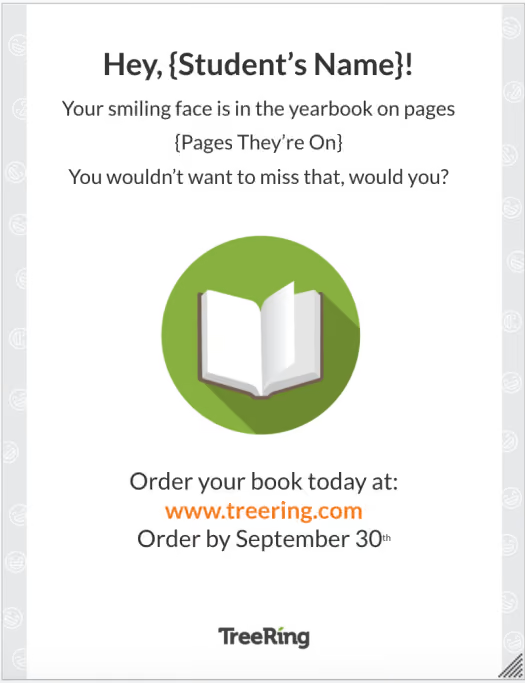
Maybe you’ve seen this type of flyer on Pinterest or heard about other schools using something like this. We certainly had. But what we hadn’t seen (or heard) was how well they worked.
So, we reached out to Angie Allen, the yearbook adviser at Elizabeth Lenz Elementary School in Nevada, to talk to her about this type of flyer. She’s used it for two years and, this year, this approached to her flyers boosted her sales by 50%.
What we’re going to do in the rest of the post is to tell you why these flyers work and, with the help of Angie, share the steps you can take to create them yourself.
Before we go any further, here’s Angie on why she created the flyers:
“I thought, if we told the students and their parents what pages they were on, it would feel more concrete than a ‘You’re probably in the yearbook.’ message... It works. We sold 227 yearbooks prior to the flyers going out and we ended up selling 370.”
Angie’s instinct was dead on. Interestingly, though, there’s a scientific reason behind it.
Think about all those headlines you see on Facebook and Twitter: “...You Won’t Believe What Happened Next” and “How I {insert amazing feat} In Just {insert ridiculously short time frame}” It’s nearly impossible not to click on those headlines, right?
If they almost feel like an itch that needs to be scratched, that’s because there’s a scientific reason for that: Those headlines are creating a
(or, if you’re being scholarly, an information gap).
Here’s the curiosity gap, as illustrated by a nine-year-old on a playground:
The theory behind the curiosity gap is based in psychology and goes like this: when we’re confronted with a gap in our knowledge, we feel a primal urge to close that gap—and we’re willing to take any action to do so.
"Such information gaps produce the feeling of deprivation labeled curiosity," wrote George Lowenstein, the psychologist who developed the theory in the early 1990s. "The curious individual is motivated to obtain the missing information to reduce or eliminate the feeling of deprivation."
More recently, a curiosity gap study has shown that we’re most curious when we know a little about a subject, but not too much. In other words, something’s been done to raise our level of curiosity.
So, how does all this science relate to your yearbook flyers?
You can use your flyers to create that curiosity gap.
Angie’s flyers did just that.
They answered the “What’s in it for me?” question by telling the student how many times he or she was in the yearbook and where he or she appeared. The trick is the second part of the flyer (where the photos are in the book), because, at that point, you’ve given the person everything but the photo.
This is where the curiosity kicks in.
(Real world example for you: Have you ever had a friend say, “Oh, my gosh! You have to see this photo I have of you. It’s so funny!” Piques your interest, right? This is the equivalent of that.)
So, how did Angie do it?
We asked her about that, and she shared her tips.
Angie said she’s found waiting to send the yearbook flyers until shortly before the order deadline is the best way to provoke someone to take action.
“We’ve had a hard time with sales at beginning of the year. People aren’t as interested then,” she said. “We’ve flooded them with flyers in the backpack and that sort of thing, but, at that time of the year, they can say, ‘Oh, I can wait.’”
By waiting until the end of the ordering window to distribute the flyers, Angie is able to create a curiosity gap and a sense of urgency. In other words, Angie is warning everyone: if you don’t act right away to find out what photos of you are in the yearbook, you might not have the chance to find out.
That’s a pretty tough warning to ignore.